
How do you write a web page or LinkedIn post that ChatGPT will quote?
Sources last checked 2026-09-28 · next check 2027-06-28, in case anything has quietly stopped being true
For UK small businesses and social enterprises. Different rules apply to big corporations like Megadodo Publishing or Sirius Cybernetics.
- Put each figure in the sentence that uses it and name its source there.
- Quote named experts in the body text.
- Use a table only when options are compared on the same points.
- Keep every fact and caveat in the main text, where the machine actually reads.
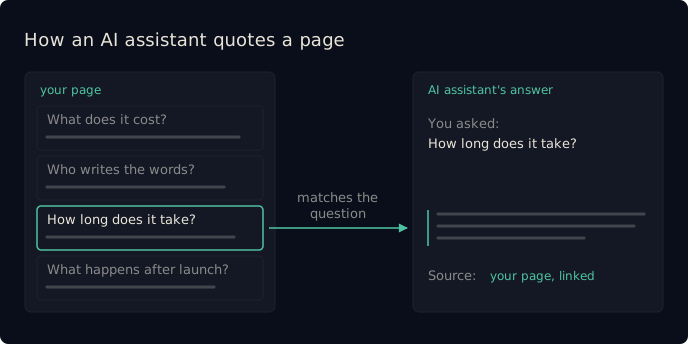
AI assistants (ChatGPT, Perplexity and the rest) and Google's AI Overviews cut a page into passages, keep the passages that match the question, and quote from those. Everything below is about making the passage they keep the one with your fact in it, and your name next to the fact.
What did the one controlled study find?
Most published advice on this subject comes from companies selling software that measures it. The exception is GEO: Generative Engine Optimization, a peer-reviewed paper from Princeton and IIT Delhi (KDD 2024). The researchers had GPT-3.5 rewrite existing web pages nine different ways, keeping the layout and length the same, and measured how much of each page an AI assistant then quoted across about 10,000 questions, repeating the test on Perplexity.
- Adding quotations from authoritative figures raised visibility by 41%.
- Adding figures in place of general statements: 32%.
- Naming sources in the sentence: 30%.
- Repeating keywords: no improvement at all, because retrieval matches meaning.
- Pages ranking around fifth gained most, so the effect is largest for pages that are already found but not first.
One detail in the study's published instructions to GPT-3.5 deserves attention. The model was allowed to invent the sources, the quotations and the figures. The study therefore shows that a page which looks well sourced gets quoted more, and it says nothing about whether the sources need to exist. Use real ones: the person reading the answer can check, and an expert you just invented is reliably not found by the one reader you were hoping to impress.
How should a figure and its source be written?
- In the same sentence. Say who published it and what it is, in plain words: “According to the government's 2026 conversion factors, ...”. The study worded its sources this way, with no reference numbers and no full titles.
- Linked from the source's name. On a web page, make the name itself the link, with no bare web address in the text. A LinkedIn post can name the source without linking it.
- A figure wherever a real one exists. “Three of the fifteen categories” can be quoted as a fact.
- In a fixed order. Meltwater's 2026 study of LinkedIn content in AI answers advises giving the figure, then its source, then what it means, followed by a short section on what to do about it.
How should an expert be quoted?
Take a direct quote from a person or organisation recognised on the subject (a regulator, a researcher, a government department) and name them in the same sentence. Put it in the body text with everything else. The study added its quotations inside the existing paragraphs and changed nothing about the layout.
When does data belong in a table?
When several options are compared on the same points. A real HTML table lets an AI assistant quote one row as a fact about one option. The same comparison written as a paragraph leaves the machine to work out which figure belongs to which option, and machines working things out is how a competitor's price ends up attached to your name. This is reasoning from how the tools work though, so caveat emptor.
- Use a real table. A picture of a table, or a grid built from page-layout boxes, loses the rows and columns.
- Use a bulleted list for everything else: single values, a list of one kind of thing, or pairs of a label and a value (“Cost: £400”). A one-column table is bloat.
- Number the steps of any process. Neil Patel's guide to optimising for AI assistants recommends bullets and numbered steps for processes, and tables for comparisons.
- Add a short list of key points. Patel's guide to search optimisation for AI treats it as a passage ready to be quoted whole.
What should the headings say?
- The question a reader would type. Every heading on this page is one. An AI assistant is matching questions, so a heading that is already a question gives it less to guess.
- The reader's own words. Write questions and answers in the language your customers use, which is rarely the language of your sector.
- Abbreviations in full the first time, in the visible text: “Privacy and Electronic Communications Regulations (PECR)”. The HTML
<abbr>tag keeps its expansion in a hidden attribute that most screen readers skip and that the programs collecting pages for AI systems commonly discard. At some point in the future, the AI companies might pay attention to the internet standards. - Alt text on every image, describing what the image shows, as Patel also recommends.
Where on the page should the facts go?
In the main text, next to the claim they support. An AI assistant that cuts a page into passages of a few hundred words will put a footnote in a different passage from its sentence, attached to nothing. A footnote should hold only a reference, link or technicality, when it's not significant if it goes AWOL.
Nothing that matters should appear only after JavaScript has run. OpenAI's and Anthropic's crawlers do not run it (Vercel, December 2024), so text built in the browser is text they never see. Tabs, accordions and “read more” buttons hide text only when JavaScript fetches or builds it on the click; text already in the HTML is read in full, visible or not.
What changes on LinkedIn?
Meltwater's study found that text posts make up 72% of the LinkedIn content AI answers cite. Of the 24 most-cited LinkedIn articles:
- every one used bulleted or numbered lists;
- 92% used headings and subheadings;
- 67% gave statistics, prices or dates;
- 50% set out the criteria they compared options on.
For a post, that means one list or short table, or a pair of before-and-after costs, and one specific figure with its source named. For an article, headings as well, and the comparison criteria stated.
Does schema markup help?
Schema markup is a set of standard labels written into a page's HTML,
telling software what the page contains. Label a page as an
Article, with its author named. FAQ markup no longer earns
anything in Google: it
stopped showing FAQ results on 7 May 2026.
On WordPress, the free version of Rank Math does this, with its schema module switched off by default (Rank Math knowledge base):
- Rank Math SEO → Dashboard, and switch on Schema (Structured Data).
- In the block editor, click the Rank Math icon at the top right and open the Schema tab.
- Choose one type for the page: Article for most answers. The free version allows one type per page.
Every source above measured being quoted by an AI assistant, and none measured whether that sends more people to your website. That is the part most people were hoping for, but those researchers at Princeton and Delhi obviously found something better to do before they got that far.
If you want to know how your own pages read to an AI assistant, I offer a free 15-minute call, and I will happily spend it on this.
More answers
- Which website carbon calculator should you trust?
- How does a small organisation work out its carbon footprint without buying software?
- What does scope 3 actually require a small organisation to measure?
- What does a net zero roadmap cost when nobody in-house does sustainability?
- Can AI build a custom tool cheaply enough for a small organisation to afford?
- How do you collect carbon data from households or members over years, not once?
- What should a website accessibility audit cover, and what does it cost?
- How do you keep a carbon reduction programme going after the first workshop?
- What is my organisation's carbon footprint?
- What should a small organisation ask for when it commissions a website?
DON'T PANIC
cyberspaceroad.com